|
|
The
mission of The Rotary Foundation is to support the efforts of Rotary
International in the fulfillment of the Object of Rotary, Rotary’s
mission, and the achievement of world understanding and peace
through local, national, and international humanitarian,
educational, and cultural programs.
The
life-blood of The Rotary Foundation has always been the enthusiastic
support of Rotarians, voluntarily giving generously of their time
and financial resources. It is this support which has made possible
the various educational and humanitarian programs of The Rotary
Foundation. These programs give Rotarians a sense of great
satisfaction and fulfillment, and reinforce the powerful network
that links Rotarians in local, national, and international service.
The Rotary Foundation focuses its strength and resources to bring
harmony and friendship to mankind and to bring understanding among
nations to achieve peace. |
1) What is
the purpose of the Permanent Fund?
The
Permanent Fund was established in 1982 to ensure a strong future for the
Foundation by providing an extra stream of income to meet the increasing
demand for the Foundation’s programs and to expand its ability to meet
urgent human needs around the world. Donors invest perpetuity in this
endowed fund which builds long-term stability for the Foundation’s
future.
Rotary
International’s Board of Directors and the Trustees of The Rotary
Foundation have identified the following programs as priorities for
program spending:
PolioPlus
Rotary
Ambassadorial Scholarships
The Rotary
Centers for International Studies in Peace and Conflict Resolution
Group
Study Exchange (GSE)
Matching
Grants for International Humanitarian Projects
Individual
Grants for International Humanitarian Programs
District
Simplified Grants for International Humanitarian Programs
Health,
Hunger and Humanity (3-H) Grants
2) How
much is spent on programs each year from the Permanent Fund?
Each year
the Trustees review the spending policy to ensure that the real value of
the Permanent Fund grows over time and that the annual spending rate
does not exceed the expected long-term rate of return less the expected
rate of inflation. In years where the inflation-adjusted investment
return is greater than the spending rate, the “surplus” will be
reinvested to cover those periods when the inflation-adjusted investment
return is less than the spending rate. During the fiscal year 2002-2003,
the policy called for spending 6.5% of the three-year average of the
Fund’s quarterly market values, with 100% of these funds being allocated
to programs. Under this policy, investment fees are deducted from the
fund’s investment income and any administrative cost is borne by the
Annual Programs Fund. This policy, coupled with strong investment
returns during the late 1990’s, dramatically increased the funds
available for program spending.
The table
below details the dollar amounts made available from the Permanent Fund
in support of annual programs of the Foundation.

The chart
below breaks down the allocation of $6,636,296 in Permanent Fund
earnings for 2002- 2003.*

*The
Trustees and Rotary districts make decisions on specific program support
for the spending portion directed to SHARE and World Fund after being
invested for up to three years through the SHARE system. The Rotary
Foundation’s 2002-2003 Annual Report provides more detailed information
on overall program support.
3)
Management of Investments
The
Trustees of The Rotary Foundation are responsible for the general
direction and control of the Foundation’s investments and have
established a specific investment policy for each fund.
Experienced, professional external investment managers are appointed to
invest Foundation assets in accordance with their judgment concerning
relative investment values and in compliance with the Trustees’
investment policies.
The
Foundation’s Trustees, staff, and investment consultant closely monitor
the performance of the investment managers and their compliance with
policy guidelines. Quarterly investment reports are sent to the Trustees
and key investment issues or concerns are discussed in depth at their
October and April meetings.
4)
Investment Structure
The
Permanent Fund is invested in four asset classes. Below is a chart that
shows the managers and composition for each of the investment pools. The
target asset allocation of the fund is 60% U.S. stocks, 20% Non-U.S.
stocks, 15% bonds, and 5% real estate.
|
State
Street Bank and Trust
(custodian bank) |
|
(60%)
U.S. Equity Pool*
managed by
Barclays Global Investors (40%)
Institutional Capital
(20%)
Trust
Company of the We
(20%)
MA
Weatherbie & Company
(10%)
High
Rock Capital
(10%) |
(15%)
Fixed Income Pool
managed by
Pacific Investment Mgmt Company (50%)
Reams
Asset Management
(50%)
|
|
(20%)
Non-U.S. Equity Pool
managed by
Capital Guardian Trust Company (100%) |
(5%)
Real Estate
managed by
UBS
Brinson
(100%) |
*The
Permanent Fund has committed $3.25 million to private equity investments
through INVESCO Private Capital and Coller International Partners. As of
30 June 2003, $650,000 has been invested.
5) What is
the investment objective for the Permanent Fund and how is the
performance monitored?
The Rotary
Foundation invests Permanent Fund assets in such a manner to ensure that
the organization provides adequate funding for today’s programs while
sufficiently growing the portfolio to support the Foundation’s programs
in the future. The primary goal is to preserve and grow the corpus at a
rate greater than inflation so that the real purchasing power of the
fund is maintained.
Over a
reasonable time period the funds are expected to achieve a rate of
return in excess of the Policy Benchmark (see below) and the
average return of similarly managed endowments.
6) What
has been the investment return for the Permanent Fund?
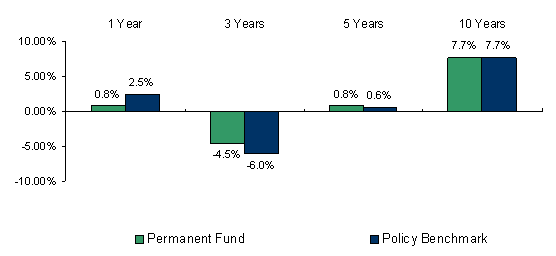
The
investment returns for the Permanent Fund are total returns net of fees.
The Policy Benchmark consists of indexes, such as the Wilshire
5000 for U.S. stocks, the Lehmen Brothers Aggregate Bond index for fixed
income securities and the Morgan Stanley All Country World ex-U.S. Index
for the non-U.S. stocks. The benchmark is weighted to reflect the target
asset allocation of the Permanent Fund during each fiscal year, and it
represents the actual performance of the asset classes. The chart below
shows the recent and long-term performance of the Fund. All periods
greater than one year have been annualized.
Through 30
June 2003
7) What
has been the growth of the Permanent Fund?
As of 30
June 2003, the net assets of the Permanent Fund, including life income
agreements, were $112.6 million. This represents a significant increase
from the $87.2 million at the beginning of the Rotary year 1998-1999. In
addition, the Foundation tracks expectancies to the Permanent Fund.
Expectancies represent commitments made for future gifts, but they are
not currently assets of The Rotary Foundation and are not included in
the financial statements.
These
commitments are typically made by including a provision in a person’s
will, or other estate plan, naming the Foundation’s Permanent Fund as a
beneficiary. The Permanent Fund’s net assets plus expectancies equaled
$356 million as of 30 June 2003.

|
(US$
millions) |
98-99 |
99-00 |
00-01 |
01-02 |
02-03 |
|
Beginning Net Assets |
87.2 |
105.2 |
119.9 |
122.5 |
113.1 |
|
Contributions and Pledges |
9.3 |
9.0 |
12.2 |
8.9 |
5.3 |
|
Investment Income |
11.2 |
9.0 |
(4.9) |
(12.7) |
0.4 |
|
Total
Spending1 |
(2.5)2 |
(3.3)2 |
(4.7) |
(5.6) |
(6.2) |
|
Ending
Net Assets |
105.2 |
119.9 |
122.5 |
113.1 |
112.6 |
|
Expectancies |
97.6 |
123.4 |
175.0 |
223.6 |
243.4 |
|
Total |
202.8 |
243.3 |
297.5 |
336.7 |
356.0 |
8) How can
I contribute to the Permanent Fund?
The
Permanent Fund provides Rotarians and other friends of the Foundation a
way to create their own lasting legacy with Rotary. Contributions to the
Permanent Fund tend to be larger than contributions to the Foundation’s
Annual Programs Fund and are often initiated through a bequest. For
special endowing opportunities for gifts of US$25,000 or more, please
refer to the Foundation’s Named Funds brochure or contact Foundation
staff directly.
1
Total spending does not match earnings available on page two due to
unused Designated Funds and some endowed scholarships not yet being
fully funded.
2
Total spending included program spending, administrative, and investment
costs.
9)
Contributing to the Permanent Fund through a Life Income Gift.
An
increasingly popular way of giving to the Permanent Fund is through life
income gifts. These gifts provide an income stream during the lifetime
of the income beneficiary. After the death of the last income
beneficiary, the remaining assets are placed in the Permanent Fund.
Because of the unique nature of life income gifts, they are managed
outside of the Permanent Fund. Life income gift assets are not included
in the spending calculations for the Permanent Fund. However, they are
included in the net assts of the Permanent Fund in the table above. The
Foundation manages life income gifts worth US$13.8 million (as of 30
June 2003). Because they have different rules and goals, each type of
life income gift has a separate investment structure. Life income
agreements may offer donors the following benefits: an annual income
stream; an immediate US federal income tax deduction; avoidance or
reduction of capital gains taxes on gifts of appreciated assets; and
possible estate tax savings. The main types of life income gifts are:
l
Charitable Remainder Trusts:
A charitable remainder trust is an irrevocable transfer of assets to a
trust in exchange for payments to the donor or other beneficiaries.
Trust payments can be fixed or provide a variable payout. Rotary’s
trusts typically maintain a fairly high equity allocation to generate
long-term growth greater than the rate of inflation.
l
Charitable gift annuity:
In exchange for an irrevocable gift off cash or securities to establish
a charitable gift annuity, The Rotary Foundation agrees to pay one or
two annuitants a fixed sum each year for life. The number of annuitants
and their ages determine the annuity rate. The payments are backed by
the unrestricted assets of The Rotary Foundation.
l
Pooled Income Fund:
An irrevocable donation of cash or securities to the pooled income fund
is invested together with the gifts of all other pooled income fund
donors. Quarterly income payments are made on a proportional share of
the Fund’s income; the amount of the payments varies with the fund’s
earnings and performance. The fund is invested in a mix of stocks and
bonds to balance the need for current income with long-term growth of
principal.
10) How is
my commitment or gift to the Permanent Fund recognized?
Anyone who
informs the Foundation in writing that he or she has made a provision in
their will or estate plan naming The Rotary Foundation’s Permanent Fund
as a beneficiary, or anyone who makes an outright gift of US$1,000 or
more to the Permanent Fund is recognized as a Benefactor. Bequest
Society recognition is extended for bequest commitments worth at least
US$10,000. Major donor recognition is presented for outright
contributions and life income gifts of US$10,000 or more. In
appreciation for outright gifts of US$25,000 or more, the Foundation
will honor the donor’s contribution by establishing a special Named Fund
within the Permanent Fund.
11) How Do
I Obtain Additional Information?
Visit
Rotary’s website at
www.rotary.org. If you are interested in learning more about life
income agreements or endowment opportunities within the Permanent Fund,
please contact Eric Schmelling, Director of Planned and Major Gifts,
your zone’s Major Gift Officer, or your local Rotary International
office.
|
Director of Planned and Major Gifts |
Eric
Schmelling |
(847)866-4458 |
|
Director of International Fundraising |
Lawrence
E. Shawver |
(847)866-3351 |
|
Senior Major Gifts Officer, Zones 23 & 24 |
David E. Bender |
(847)866-3456 |
|
Major Gifts Officer, Zones 22, 25 & 26 |
Open |
(847)866-3354 |
|
Major Gifts Officer, Zones 27, 28, 29 & 30 |
Open |
(847)866-3354 |
|
Major Gifts Officer, Zones 31, 32, 33, 34 |
Jackie McGuire |
(847)866-4450 |
|