新世紀的挑戰
A Challenge
for the New Century
職業道德
Working Ethics
水門案、戰爭、和四大考驗
Watergate, war, and The Four-Way Test
(扶輪月刊2004/3, Rotannmag.rotary.org的一月號電子雜誌)
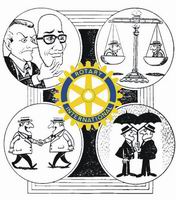
曾經在1970年到1973年擔任當時美國總統尼克森白宮顧問的律師狄恩,於2003年5月3日在第5670地區(美國堪薩斯州)年會中發表演說。祖父是扶輪社員的狄恩探討如果當時主掌白宮的是扶輪社員,在水門飯店可能會發生的事。(身為扶輪名譽社員的尼克森因隱瞞侵入民主黨全國競選委員會總部的舉動而面臨彈劾,於1974年辭去美國總的職位。) 狄恩的演講以新的角度來審視這個美國歷史上影響最重大的決定之一,以下刊登其中演講的精華摘要。
「如果我們當時曾停下來,運用四大考驗的話,水門案便不會發生。」──約翰.狄恩
|
|
|
|
|
約翰.狄恩 John W. Dean III |
|
|
|


自1943年起,各地的扶輪社便仰賴──並與他人分享──一個十分簡潔有力的道德檢驗工具。這個檢驗不是法律,不是教條、也不是宗教。相反地,它是一個自我評估工具──說得更簡單些,是一個幫助人說正確的話,做正確的事的檢查表。
如果四大考驗有不足之處或有缺失,在經過超半世紀的使用之後,那便是保存十分好的秘密。相反地,四大考驗已經證明經得起時間的考驗。
瞭解到這一點,我決定讓四大考驗接受嚴格的檢驗。一開始我自問在水門案期間擔任總顧問時如果我應用這項準則,可以獲得什麼樣的指引。可是後來我想到一個更迫切、更重要的問題──當時和伊拉克之間一觸即發的戰爭。讓我簡單告訴各位我的發現。
是否一切屬於真實?
令人遺憾,總統經常覺得有必要隱瞞部份有關戰爭的事實。這是一個所有關心的公民都應該問的問題,如果我們無法得知事實,那麼我們的制度基本上便有缺失。
是否各方得到公平?
有哪一場戰爭能夠對所有當事者都公平的?當薛曼帶著火把橫掃喬治亞州,對南方的莊園主人是否公平?那在上一個世紀所有死於戰爭中的士兵和平民呢?一場戰爭要對所有當事者公平必須公正無私地進行,而且必須是誠實的。這樣的戰爭也必須是不為一己之私利。這樣的戰爭必須循既定的戰爭法則,必須師出有名,且具重要性。
能否促進親善友誼?
如果發動戰爭的理由並不真實,如果戰爭的行為並不公平,那麼這場戰爭顯然無法促進親善友誼。
能否兼顧彼此利益?
你無法認識所有與戰爭相關的人。我相信泰勒(四大考驗的作者,扶輪社員泰勒)並非要各位知道它如何影響了你沒有直接或間接影響的人。
這項測試的關鍵並不一定是回答問題。而是問自己這些迫使你做的事:思考──瞭解你的言行對他人的影響。你將會發現該說的話和該做的事。或者我應該說,說什麼和做什麼對你而言才是正確的。
我祖父一生都是一位活躍的扶輪社員,我第一次和他出席扶輪例會時才10歲左右。可是卻是直到貴地區的總監提斯里(Mack Teasley)提到四大考驗時,我才真正意識到它的存在。我現在使用它的次數已經不可勝數。我已經使它成為我思考的一部份。事實上,我希望要是自己能早一點認識它就更好了。
我的太太茉琳問我:「你在演講中不打算回答這些關於戰爭的問題嗎?」我相信四大考驗的宗旨並不在於由我來告訴各位答案。各位也不必告訴我你的答案。四大考驗不是講道的大綱,也不是演講的題材,更不是在尋求每個問題的明確答案。我把四大考驗當作個人的省思工具,每個人都可使用的自我檢討提綱。
在此我不怕自相矛盾地要告訴各位,如果當時在尼克森白宮裡我們這些有參與的人曾稍稍停下來,運用四大考驗來思考的話──即使只是偶爾為之──水門案便不會發生。簡單來說,四大考驗真的有用。如果我們願意使用它,它對任何問題都有用。
本篇演講的全文請參照下列Rotannmag.rotary.org的一月號電子雜誌。
Watergate, war, and The Four-Way Test
|
|
|
|
|
約翰.狄恩 John W. Dean III |
|
|
|
U.S. lawyer John W. Dean III, who served as White House counsel from 1970 to 1973 under President Richard M. Nixon, addressed the District 5670 (Kansas, USA) Conference on 3 May 2003. The grandson of a Rotarian, Dean examined what might have taken place at the Watergate Hotel if Rotarians had been in charge of the White House. (Nixon, an honorary Rotarian, resigned as U.S. president in 1974 under threat of impeachment for covering up a break-in at the Democratic National Committee headquarters.) Dean's speech, which provides a new perspective on one of the most fateful decisions in U.S. history, appears in The Rotarian's January issue, edited for length. Here, we provide the full text of the speech.
Since 1943 Rotary Clubs everywhere have looked to, and shared with others, an ethical testing tool that is wonderfully simple and remarkably telling. As most of you know, this ingenious little four-pronged test, developed in 1932 by Chicago businessman Herbert J. Taylor, who years later became the president of Rotary International, consists four fundamental questions:
1. Is it the Truth?
2. Is it Fair to all concerned?
3. Will it build Goodwill and Better Friendships?
4. Will it be Beneficial to all concerned?
To test his tool Mr. Taylor first employed it in his own life. He tested it with his colleagues and business associates. Pleased with the result he soon took it to Rotary, and the rest is — as they say — history. Rotarians throughout the world adopted the Four Way Test as their own, and have used it for six decades in their lives, in their businesses and in their communities. This test is not a code, not a creed, not a religion. Rather it is an assessment device, a basis for inquiry, a structured analysis, or more simply stated — a checklist to help one find the right thing to say or the right thing to do.
If The Four-Way Test has been found wanting, or somehow defective, after over a half-century of its use, it is a well-kept secret. To the contrary, Rotary's Four-Way Test has only proven itself more reliable with the passing of time. The reason for its success is obvious — truth, fairness, friendliness, and community assistance are timeless necessities in human dealings. They are no less than Golden Rule standards.
It was with this reality in mind, that I decided to put The Four-Way Test to a critical examination. It started with my asking what kind of guidance might I have gotten as counsel to the president during Watergate, if I had applied it?
But I must confess before I started examining Mr. Taylor's test in the context of Watergate, I found myself thinking about more current and more important problem, the potential of a war with Iraq — which was then looming. Before testing it with Watergate, I decided to put The Four-Way Test to the test of war.
While I am not aware if there are any active Rotarians in the current Bush White House, I am aware that there are many evangelical Christians on the president's staff. The Four Way Test is a purely secular undertaking. I am told (by a very reliable source) that a number Christians at the Bush White House were asking how Jesus might handle a character like Saddam Hussein? I don't know what answer or answers were found. But I don't believe that question necessarily trumps The Four-Way Test. I say that because I went looking for answers to all these questions.
Unlike a couple of my former White House colleagues, and onetime Watergate co-conspirators, Jeb Magruder — who returned to Princeton and became a Presbyterian minister, and Chuck Colson — who became a born-again Christian and founded a Prison Ministry — I am just one of the flock. I have no theological credentials whatsoever. So to get a fix on the question of what Jesus might do about war, I turned to those with theological expertise. And to those who have thought long and hard about this question.
I didn't have to read very long before it became apparent that for Christians there is no simple answer to questions about war. One can find Christian theologians who are convinced that the teachings of Jesus preclude war. While others find His teachings justify war. Not to mention a lot of cross fire in the mix about who is right and who is wrong, and what exactly the Bible means in this area.
Christian thoughts on war run from the pacifist at one end of the spectrum to the crusader at the other end, and in between you have what is considered the moderate position that condones a "Just War." This appears to be the most prevalent position in this country.
As you might expect, lengthy treatises have been written on what is and what is not a Just War. Just War teachings suggest how all combatants should act in battle. They don't try to justify war, rather these thinkers are trying to establish guiding principles for engaging in war.
While it was interesting to read about Just War, again, there is much debate in these writings. So let me cut to the bottom line. I want to tell you that the purely secular Four Way Test cuts through a lot of hotly debated, often deeply nuance, theological discussion and arrives in the end at a very similar place.
Let me briefly tell you what I found in applying The Four-Way Test to war.
Is it the Truth?
As I perceive it in the context of war, the first question — Is it the Truth
— asks if there is a true reason to go to war, as opposed to not going to
war.
Unfortunately, history teaches us that the reasons for war are not always what they appear. Sadly, presidents often find it necessary to be less than truthful about war.
In 1916 Woodrow Wilson campaigned for reelection as president on the promise that he would keep America out of World War I.
In 1940 FDR campaigned by telling mothers and fathers in Boston: "I have said this before, but I shall say it again — Your boys are not going to be sent into any foreign wars."
In 1964 Lyndon Johnson pledged repeatedly during the campaign against Barry Goldwater that American boys would not be sent to the jungles of Vietnam to die.
It strikes me that the first question of The Four-Way Test is as potent a question as one might ask about any war. It is a question that all interested citizens should want to ask, and if we cannot get the truth, there is a fundamental flaw in our system. But let me turn to the second prong of The Four-Way Test, because I believe that the way the questions are asked is as important — if not more important — than the answers.
Is it Fair to all concerned?
The second question in The Four-Way Test is, of course — Is It Fair To All
Concerned. Fairness is like Truth, and it is subjective. It is certainly not
a true test of Fairness to claim — as some might — that "all is fair in love
and war." To ask if a war is fair, is to test whether the means is
appropriate to the end.
Ethicists will tell you that Fairness is a subject that is more debated and open to varying interpretation than any other ethical value. What is fair to me may not be fair to you. Actually it is easier to recognize what is unfair, rather than what is fair.
Let me pause just to note that in reading the history of Mr. Taylor's Four Way Test, it is evident that he did not seek to pose deep ethical issue for resolution, he was not creating a matrix for philosophers and ethicists to explore, rather he was looking for simple answers to rather simple questions. It was this reality, of not making the simple unnecessarily complex, that I kept reminding myself as I explored these issues.
For example, I found I had to constantly remind myself of this fact as I thought about war.
Can any war ever be fair to ALL concerned? Was it fair to the Southern plantation owners when Sherman crossed Georgia with a torch? Was it fair to all Americans when Woodrow Wilson prosecuted and jailed citizens who were critical of the First World War effort? How about the incarceration of Japanese Americans during World War II — was that fair? And what about ALL the soldiers and civilians who died in wars during the last century, a century that stands as the bloodiest and deadliest in the history of mankind?
I doubt any one would claim any of these war-related actions, viewed in hindsight, could be considered fair. But I think the examples I just cited are examples of how not to apply The Four-Way Test. I believe that to answer this second question, as with all the questions Mr. Taylor intended to asked, it must be done by setting aside any preconceived notions. Also look carefully at the words Mr. Taylor selected. With this second question, one has to start with the word "fair." What are we talking about when we talk of being fair? Of course this is a subjective question, but it strikes me it can be examined in an objective fashion.
Webster's New Collegiate Dictionary defines the word fair as, "marked by impartiality and honesty; free from self-interest, prejudice or favoritism; conforming to the established rules; consonant with merit or importance."
In short, for a war to be fair to all concerned it must be pursued impartially and that pursuit must be honest. Following the definition of fair, further, the war must also be free from self-interest. The war must be executed free of prejudice and favoritism. And the war must conform with established rules of war, have merit and have importance. In short, a war that meets the definition of fair — is (to be rhetorical) by definition a fair war.
I must tell you that applying the fairness standard to war, and the definition of what is fair, you find yourself considering the same types of the issues that are considered by theologians in their debate about Just Wars.
So it is clear that the second question of The Four-Way Test is vitally important. And for all practical purposes it forces one to think in a secular way about the concepts theologians consider in determining if a war is a "Just War."
Will it build Goodwill and Better Friendships?
Let me turn to the third question of The Four-Way Test — Will it build
Goodwill and Better Friendships?
The answer to this question, I submit, will be influenced first by whether we are engaged in a defensive war or an offensive war. Needless to say, war is not a typical strategy found in Dale Carnegie's "How To Win Friends And Influence People." But the answer to this question will also be influenced by the answers to the first two questions of The Four-Way Test.
The deeper I got into The Four-Way Test, I realized it comes with a very precise set of instructions about how to use it. The four questions are to be asked in a given order, not randomly. It is not until you have answered whether it is Truth, and whether it is Fair, that you address the question of whether it will result in Goodwill and better Friendship.
If the reason for the war is not true, if the conduct of the war is not fair, it is rather obvious that the war is not going to create goodwill and better friendships. Indeed, I submit to you that with many matters that you may never get to the last two questions, if you cannot find acceptable answers to the first two questions.
This is not to say that third and fourth questions are not important, because in many ways they draw out your earlier answers. But let me proceed to the last question, so I can move to the larger picture that was emerging for me — in my testing of Mr. Taylor's four way test.
Will it be Beneficial to all concerned?
The last question — Will it be Beneficial to all concerned? — is like the
second — it applies to ALL concerned. The second question, of course, is
whether is Fair to all concerned. When one gets to war, or any matter
relating to the actions of a nation, or a government of that nation, the ALL
CONCERNED involves great numbers of people. How does one know who all is
concerned? How does one know whether the war helps or hurts all who might be
concerned? Is this an impossible question in the context of war, or for that
matter any government policy? Will there not always be people who believe
that they are, and others that they are not, benefiting from war, or some
other government policy? Aren't there always partisans?
The obvious answer to my questions is that you can't know all who are concerned. I don't believe that Mr. Taylor wanted you to know how it affected persons with whom you have no direct or indirect impact. In administering this test in many situations you will not be able to know if what you say or do is fair to all concerned, or beneficial to all concerned. Not only is it difficult to know the reach of any statement or action, or in this case, the ramifications of war, for there will always be differences in perception and opinion.
But to raise these problems is only to point out what I believe to be the true beauty of The Four-Way Test. After looking for answers to these questions, what Mr. Taylor's code really does — what it forces — finally dawned on me. The key to this test is not necessarily the answers to the questions. Rather it is what asking the questions forces you to do — to think. To appreciate the impact of your words and actions on others. From this thinking process, you will discover the right thing to say or the right thing do. Or I should say, what is right for you to say and do.
Purpose Of The Four-Way Test
I was about ten years old when I attended my first Rotary meeting with my
grandfather — who was an active Rotarian his entire life (and it was a long
one, for he lived almost 100 years). But it was not until your District
Governor, Mack Teasley, mentioned The Four-Way Test that I became truly
aware of it. I've not only tested it with war, but I have now tested it more
times than I can recall. I've made it part of my thinking. Indeed, I only
wish I had known about it earlier.
It was at about this point in drafting of these notes for this talk that my wife, Maureen, or "Mo" as she is known to me, happened to read the material. Aren't you going to answer these questions on war in your talk, she asked? Aren't you going to say whether you found the president's explanation for the war with Iraq is the Truth? Was the war Fair to all concerned? Has it built Goodwill, and was it Beneficial to all concerned?
My answer to her, is my answer to you. There is a reason I've not given you my answers. I don't believe The Four-Way Test is designed for me to tell you my answers. Nor for you to tell me yours. The more I worked with the test, the more I felt I understood what Mr. Taylor sought to accomplish.
The Four-Way Test is not an outline for a sermon. It is not a design for a lecture. Nor is it a search for the definitive answer to each question.
To the contrary, as I perceive The Four-Way Test it is a personal reckoning device, a private syllabus for each of us to employ on his or her own and to find the answers for themselves.
As I told my wife, the most important part of The Four-Way Test strikes me as the mere use of it, the honest search for answers to its questions. I guarantee to anyone who has never truly worked through The Four-Way Test on any vexing issue that they will find that it opens up hidden corners of your thinking that will surprise you. I guarantee you that it will sharpen your perception of any issue you address — after you go through the exercise.
I entitled my remarks: Testing Rotary's Four-Way Test With War And Watergate. I mentioned at the outset I have recently applied The Four-Way Test to Watergate.
I am going to tell you without fear of contradiction that had those of us in the Nixon White House who were involved in Watergate stopped to apply The Four-Way Test — even if only occasionally — there would have been no Watergate. In short, The Four-Way Test works. It works for war — the toughest test I could think of testing it against. It will work for any issue — if only we are willing to use it.