再聯繫 通訊 (心繫扶輪)2011年 4月發行
|
|
|
|

前扶輪獎學生出版童書
Maureen Vaught報導,國際扶輪新聞,
By Maureen Vaught
Rotary International News -- 25 February 2011
3520地區2004-2005年度文化大使獎學生柯懿芳Zoe
(Ko, Yi-Fang)譯
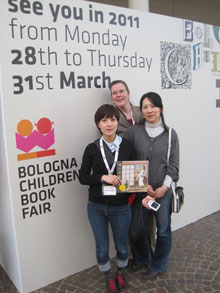 |
從左至右:Nishimura、Bracklo及Funatsu一同出席2010義大利波隆那的童書博覽會。照片由Bracklo所提供。 From left, Momo Nishimura, Gabriela Bracklo, and Keiko Funatsu attended the 2010 Bologna Children’s Book Fairin Italy. Photo courtesy of Gabriela Bracklo |
|
兩位前扶輪文化大使獎學生透過日本童話,讓德國幼童增進對不同文化的瞭解。
Two former Rotary Foundation
Ambassadorial Scholars are introducing
cultural understanding and communication
to young German children through the
retelling of a popular Japanese fairy
tale.
1992-1993年的德國獎學生Bracklo以及2004-2006年的多年期日籍獎學生Funatsu,她們跟指導教授Nishimura共同出版了「美麗的仙鶴」,也就是日本童話「仙鶴報恩」的德語版本。此書自從2009年十月印行以來,已經Bracklo的故鄉
-
慕尼黑的圖書館、書展博覽會等相關活動中造成轟動。
Gabriela Bracklo, a 1992-93 scholar from
Germany, and Keiko Funatsu, a 2004-06
multiyear scholar from Japan, worked
with illustrator Momo Nishimura to
produce Dank des Kranichs (The
Grateful Crane), a German version of
the Japanese story Tsuru no Ongaeshi .
Since its release in October 2009, Dank
des Kranichs and its illustrations
have been featured at libraries, book
fairs, and festivals throughout Munich,
where Bracklo lives.
Funatsu說:「透過日本童話讓德國孩童增進跨文化的溝通瞭解,從念頭從一開始就非常吸引我。」Funatsu主要負責「仙鶴報恩」的排版以及翻譯,然後由Bracklo構想此書並擔任出版者。
“From the beginning, the idea of
improving cross-cultural communication
by introducing Japanese fairy tales to
German children appealed to me,” says
Funatsu, who edited and translated Tsuru
no Ongaeshi into German. Bracklo
conceived the idea for the book and
served as its publisher.
Funatsu與Bracklo是在慕尼黑大學修讀德國文化與文獻探討課程時所認識的。Bracklo是慕尼黑巴伐利亞扶輪社的會員,同時也擔任扶輪基金會第1840地區前受獎人小組委員會的主委。Bracklo常常帶她的女兒出席前受獎人的聚會活動,兩人都為Funatsu以及其他日籍伙伴所講的故事所著迷。
The two met while Funatsu was studying
German culture and literature at Ludwig-Maximilians-Universit螩t
M詉nchen. Bracklo, a member of the Rotary
Club of M詉nchen-Bavaria and chair of
District 1840’s Rotary Foundation alumni
subcommittee, often took her daughters
to alumni events, where they were
captivated by the stories told by
Funatsu and fellow Japanese scholars.
在找不到德文翻譯者的情況下,Bracklo跟Funatsu講了出版童書這個主意。她同時也連絡了在出版業的朋友,很多人都無條件地貢獻他們的專長與時間在這個童書出版計畫。Bracklo與Funatsu憑藉著在扶輪多年的經驗,使她們對於完成這個計畫更有信心。
Unable to find German translations of
the stories, Bracklo approached Funatsu
with the idea for the book. She also
contacted friends in the publishing
business, many of whom volunteered their
time and expertise to the project. Both
Bracklo and Funatsu credit their years
as Rotary Scholars with giving them the
confidence to pursue this project. 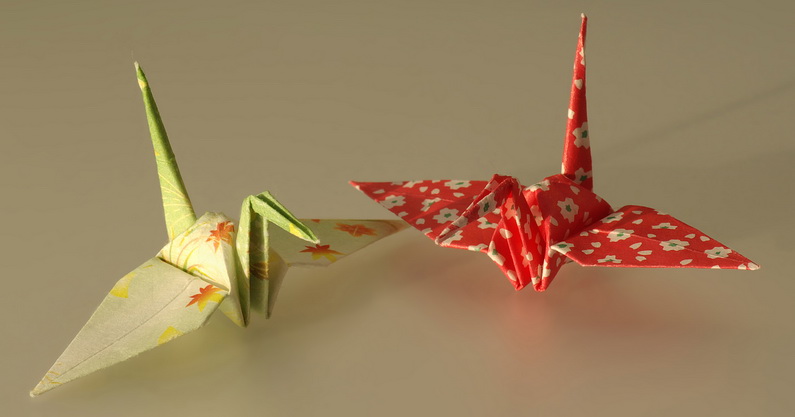
附錄摺紙
Origami included
Bracklo以前在Santa
Cruz的加州大學主修新聞,她說:「我並不是被培養要從事這樣的教育志業,而是剛好我很幸運生長在一個開放、積極且樂觀的環境,這些特質一直跟著我。」
“It’s not in my upbringing to do this
kind of thing. But I had the chance to
live in an open-minded, positive, and
outgoing environment, and I brought that
home with me,” says Bracklo, who studied
journalism at the University of
California, Santa Cruz.
在要開始這個工作之前,她們得先挑選與過濾故事版本,因為日本童話可以有很多變化,不像德文版本具有較高的相似度。
Before beginning work on the story, the
women had to choose which version to
tell because Japanese folk tales, unlike
their German counterparts, can have a
number of variations.
Bracklo說:「我們挑選這個版本的原因之一,是因為它的重心在日本新年,這是日本最重要的節慶之一。」透過Nishimura的帶領,德國孩童可以清楚地瞭解一個典型的日本家庭,包括衣著、食物或是慶祝節日的方式。
“One of the reasons we chose this
version,” says Bracklo, “is because it
focuses on the Japanese New Year, one of
the most important holidays in Japan.
Through Nishimura’s illustrations,
German children can see a typical
Japanese home, how they dress, what they
eat, and how holidays are celebrated.”
每一本書裡都附有一張可折出紙鶴的摺紙,並有詳細的圖示解說。
Each copy of the book is accompanied by
origami paper and a folding diagram that
includes instructions for making a
crane.
雖然Nishimura本身並非扶輪社員,但她跟扶輪還是有很深的關係:她在2010年嫁給了前扶輪獎學生Nishikawa,兩人是在慕尼黑的扶輪基金會前受獎人會議中認識的。
Although not a scholar herself,
Nishimura also has a Rotary Foundation
connection. In 2010, she married former
Rotary Scholar Keiji Nishikawa, whom she
met at a Foundation alumni meeting in
Munich.
除了要把日本文化介紹給德國青少年之外,Dank
des Kranichs每賣出一本書,就捐款1.5歐元(2元美金)給根除小兒麻痺計畫。到目前為止,已經募得了大約700歐元(美金944元)。
In addition to introducing Japanese
culture to Germany’s youth,
Dank des
Kranichs is raising money
to help eradicate polio. For every book
sold, €1.50 (US$2) is donated to
PolioPlus. To date, about €700 ($944)
has been raised. 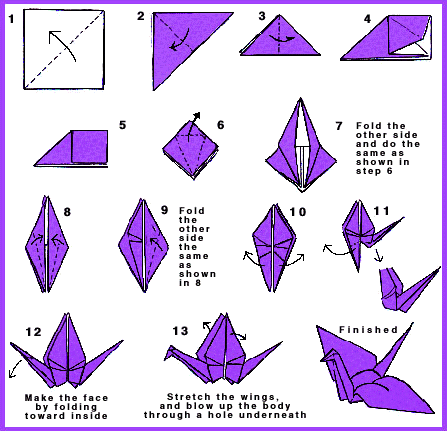
Funatsu在日本東京的立命館大學教德文,她說她正在找適合的德國童話,準備翻譯給日本孩童。同時,有另外三位同事也已經著手在另一本新書「桃太郎」,預計於今年底在德國發行。
Funatsu, who teaches German at the
Ritsumeikan University in Kyoto, Japan,
says she is looking for the right German
folk tale to translate for Japanese
children. In the meantime, the three
literary colleagues have already started
work on a new book, Momotaro, the
Peach Boy, which is planned for
release in Germany later this year.
Bracklo說:「我們的第一本書的背景是在冬天,並有一位漂亮的女性跟一隻仙鶴。第二本書的背景則設定為夏天,內容則是有關一個日本男孩與魔鬼戰鬥的故事,這是一本比較男孩子的故事。」
Says Bracklo: “Our first book was set in
the winter and featured a graceful woman
and crane. The second book is set in the
summer and is about a Japanese boy who
fights demons. It’s more of a boy’s
book.”
跟第一本書一樣,「桃太郎」的收入將會有一部份捐給根絕小兒麻痺症的計畫。
As with the first book, a portion of
sale proceeds from Momotaro will
be donated to PolioPlus. |
|
|
|
|
|
|
|