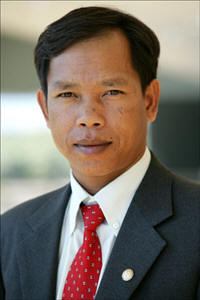
|
丹麥哥本哈根報導
— 1975
年被赤柬送入勞改營時,希安Path
Heang
只是個小男孩。 |
Copenhagen, Denmark — Path Heang was just a boy in Cambodia when
in 1975 the Communist Khmer Rouge forced him into a labor camp. |
|
年幼的Path
Heang
和他的雙親被送入不同的勞改營,之後數年他被分配到不同的單位工作。他曾在稻田上揮汗,
挖運河,
牧牛羊,
蒐集糞便做堆肥。有一次他放牧的牛走失了,為了懲罰他,
一名赤柬官員將他绑在爬滿螞蟻的樹上。 |
Separated from his parents, who also were sent to camps, he
spent the next several years in various work facilities. He
toiled in rice fields, dug canals, collected dung for
fertilizer, and herded cattle. Once, when some of the cows
wandered off, as punishment a Khmer Rouge official tied him to a
tree crawling with biting ants. |
|
Path Heang
每天從早上7
點工作到日落,
每日只吃午晚兩餐,
每餐都是湯和清清如水的米粥。他全年穿著同一條的褲子、襯衫和圍巾,
無論是濕是乾。全身的衣物就是所有的財產,
生病了也不會有人照顧。他大部分時間都睡在地上,有時睡在臨時搭建的竹床。 |
Heang worked from 7 a.m. to sundown, and ate only two meals a
day: soup and watery rice porridge for lunch and the same for
dinner. For an entire year, he wore the same pair of pants,
shirt, and scarf — regardless of whether they were wet or dry.
They were all he had. If he got sick, no one took care of him.
He slept on the ground and sometimes on a makeshift bamboo bed. |
|
某晚Path
Heang
半夜醒來發現有一位婦女將他抱在懷裡,
溫暖的擁抱讓他很快地又回到夢鄉。醒來後他發現圍巾裡有些暖暖的東西,打開後發現是一些葉子。原來是那位婦女一早起床,撿了些葉子,
煮熟後留給他吃。他嚼著葉子,
甚至還能感到她在裡面放了鹽。之後,那位婦女就不曾再出現。 |
One
night, he awoke to find himself tightly wrapped in a woman's
arms. Her warmth felt so good that he drifted back to sleep.
When he awoke, she was gone. Then he noticed something warm
wrapped in his scarf. He unfolded it and found some leaves. The
woman had risen early, gathered the leaves, boiled them, and
left them for Heang to eat. He chewed them and could taste the
salt she had added to the water. The woman never returned. |
|
「我不知道她就是我母親」Path
Heang
回答後沈默許久,不願再就此多談。 |
"I did not know she was my mother," Heang says. A long pause
follows. He doesn't want to talk about it anymore. |
|
|
|
|
運氣與決心 |
Luck
and determination |
|
今日37
歲的Path
Heang
已是世界銀行柬埔寨辦事處的計劃主管,
也是前扶輪世界和平獎學金學者。這表示他曾獲扶輪基金會獎學金贊助攻讀和平與解決衝突的碩士學位。他於哥本哈根國際扶輪第97
屆年會中提倡「世界和平獎學金」(World
Peace Fellows
)計劃時表示「我今天能一路走到這裡靠的是運氣」。 |
Today, Heang, 37, is a program officer for the Cambodia office
of the World Bank. He's also a former Rotary World Peace Fellow,
meaning he received a scholarship from The Rotary Foundation to
carry out graduate studies in peace and conflict resolution.
"How I worked my way to where I am now is luck," he said
modestly while in Copenhagen promoting the World Peace Fellows
program at Rotary International's 97 th annual convention. |
|
Path Heang
於1979
年越南軍隊推翻赤柬後與母親重聚,才知道當時偷偷去找他的那位婦女就是他母親。她當時正好和一群人一起前往另一個勞改營,中途於Path
Heang
所在的勞改營過夜。 |
Heang reunited with his mother in 1979 when Vietnamese troops
overthrew the Khmer Rouge. He eventually learned that she was
the one who had visited him. She had been passing through with a
group en route to another camp, and the group stayed overnight
at Heang's camp. |
|
赤柬倒台後,
希安開始上高中。由於當時由越南支持的政府禁止學習英文,
因此Path
Heang
只能暗地裡偷學英文。他當時已從聯合國兒童基金會提供的食用油、魚罐頭和玉米罐頭上的標籤上學了一些英文字。 |
After the Khmer Rouge collapsed, Heang went on to high school,
where he secretly studied English because the Vietnamese-backed
government forbade it. He already knew some words from reading
labels on the cooking oil and cans of fish and corn provided to
his family by UNICEF. |
|
他和他同學們曾經因此兩次在聚會地點被警察逮捕,
並在獄中待了數晚。每次被捕後,他們就會更改聚會地點。他們的第三個聚會點是在一間沒有屋頂的廢屋裡,他們在晚上把三樓關起來當教室,在白色的牆壁上寫字。 |
Twice, police discovered where he and his classmates were
studying and put them in jail for several nights. After each
arrest, they moved to another location. For their third hideout,
they chose the third floor of an abandoned, roofless building
where they met at night and wrote on the white walls. |
|
|
|
|
職涯與理念 |
Careers and causes |
|
大學畢業後,Path
Heang
從事過幾份工作,
在這些工作中他參與了一些活動,
協助貧窮的柬埔寨農民增加作物收成,
幫助柬埔寨人民繳回武器給政府當局,
以及協調成立一個負責解決柬埔寨勞工糾紛的工作小組。 |
After college, Heang held various jobs, some of which involved
helping poor Cambodian farmers increase their crop production,
getting Cambodians to turn in their weapons to authorities, and
coordinating a team that established mechanisms to resolve labor
disputes in Cambodia. |
|
2003
年他前往澳洲布里斯班昆士蘭大學(Rotary
Center for International Studies)
扶輪和平及解決衝突國際研究中心就讀。已婚並育有2
子的Path
Heang
於2004
年畢業,順利獲得國際和平與解決衝突碩士學位。 |
In
2003, he moved to Australia to study at the Rotary Center for
International Studies at the University of Queensland in
Brisbane. Heang, who is married and has two children, graduated
in 2004 with a master's degree in international studies in peace
and conflict resolution. |
|
在世界和平獎學金課程結束後,
他回到柬埔寨為一間研究機構工作。工作內容包括協助政黨、非政府組織、以及政府解決因選舉進行方式造成的糾紛。 |
After his World Peace Fellowship ended, he returned to Cambodia
and worked for a research institute. Part of his job was to help
political parties, nongovernmental organizations, and the
government work out disputes over how elections were being run. |
|
Path Heang
於8
月開始為世界銀行工作,進行一項名為「貧者的公義」(Justice
for the Poor)
的計劃。該計劃的目標為透過法庭以外的方式解決與土地、自然資源管理、以及地方政府相關的糾紛,
因為當地人們普遍認為法院都是腐敗不可信的。 |
In
August, he started his job at the World Bank and is working on a
project called Justice for the Poor. It aims to get disputes
involving land, management of natural resources, and local
governments resolved outside the courts because they are widely
believed to be corrupt. |
|
雖然不是在政府單位,但Path
Heang
還是希望最後能成為資深的決策者。他說「我的目標是擔任一個能夠幫助許多柬埔寨人民的職位。」 |
Ultimately, Heang aims to be a senior level policy-maker,
although not in the public sector. "My goal is to get into a
[position] where I can help a larger portion of Cambodians," he
says. |